
AI & Automation ·
Part 6 — The road to BluCanto: the point was never the product
This is the finale, and everything in this series has been climbing toward this final rung in the ladder. The simple wins, working in the folder, the DevShop, the local-versus-cloud thinking — all of it converged on one real, live product with real paying customers. That product is www.blucanto.com. But I want to be honest about something up front: this post isn't really about BluCanto. It's about the process that produced it, because that's the part you can copy.
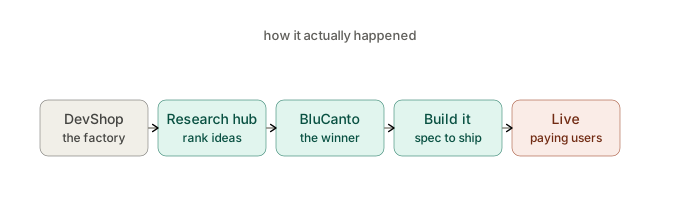
Let me tell you how it actually happened, because the path matters more than the destination.
It started with the factory. In Part 4 I described the DevShop — the harness that runs my SAP-style lifecycle with AI agents. Once I had a reliable way to build real things that actually work and are also maintainable, a bigger question surfaced: could AI help me decide what was worth building in the first place? That became a project of its own — less a company than a research engine. I used it to study how autonomous agents work, and then I pointed it at business itself: I had it research and rank dozens of business ideas, scoring them on demand, competition, and how realistically a solo operator could take one to a million dollars in revenue.
That ranking exercise is where BluCanto was born. One idea kept rising to the top — a tool to do for other people exactly what I'd just done for myself: cut through the paralysis of "what should I even build," with data instead of guesswork. I believed in it enough to stop researching and start building. I doubled down, and I ran it through the DevShop method end to end — discovery, a proper PRD, a gated build, a test suite, blue-green deployment — until it was live at www.blucanto.com, taking payments from strangers on the internet.
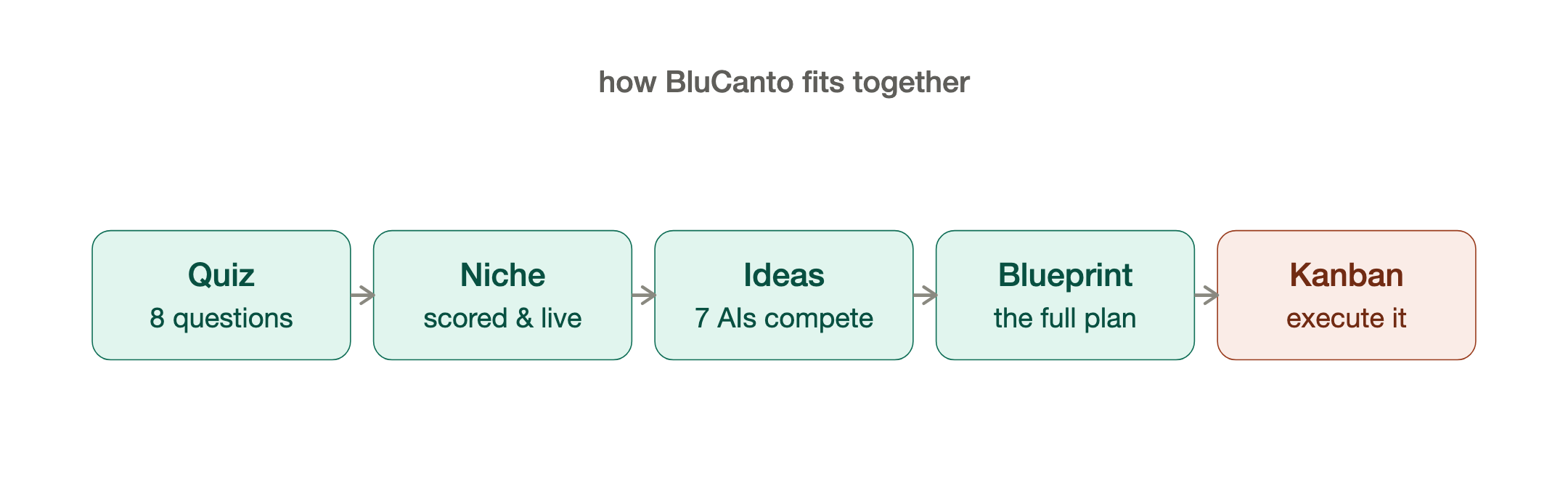
So what is it, concretely. BluCanto walks someone through a short quiz, matches them to a business model and a niche, generates a set of scored business ideas, and then produces a full twelve-month business blueprint with financials and a live Kanban board to actually execute it. Simple on the surface. Underneath, it's the opposite of a thin "ChatGPT wrapper," and the clever bits are exactly the things this series has been about:
The niche engine isn't a hardcoded list. A separate pipeline pulls live signals from free sources — Google Trends, YouTube, search results, Etsy, Reddit — and scores hundreds of niches every week on five weighted criteria into a single viability score. That pipeline is good enough to be a product in its own right.
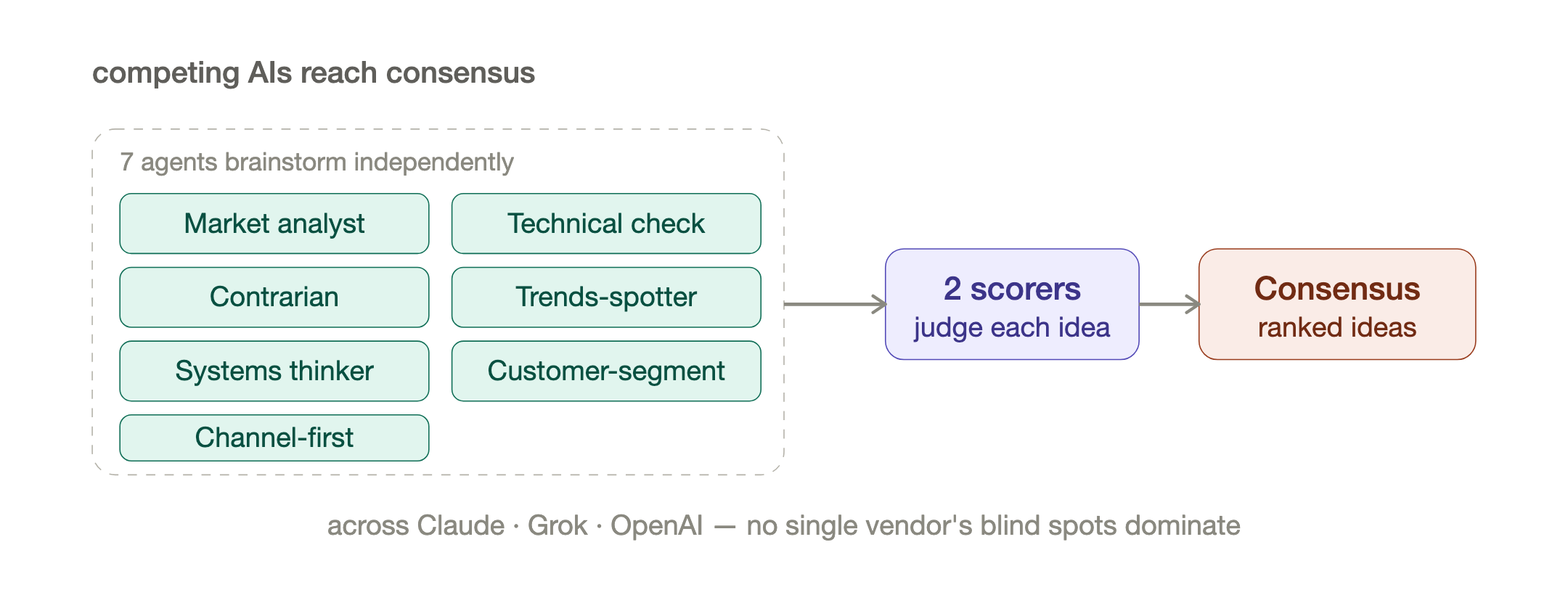
The ideation uses competing AIs. When you ask for ideas, it doesn't ask one model. It runs seven different AI agents in parallel, each with a distinct persona — a market analyst, a technical-feasibility check, a deliberately contrarian strategist, a trends-spotter, a systems thinker — and deliberately across different vendors, Claude, Grok and OpenAI, so no single provider's blind spots dominate. They each brainstorm independently, then two separate scoring models judge every idea and reach a consensus ranking. It's a little AI democracy, and it produces far better ideas than any one model alone.
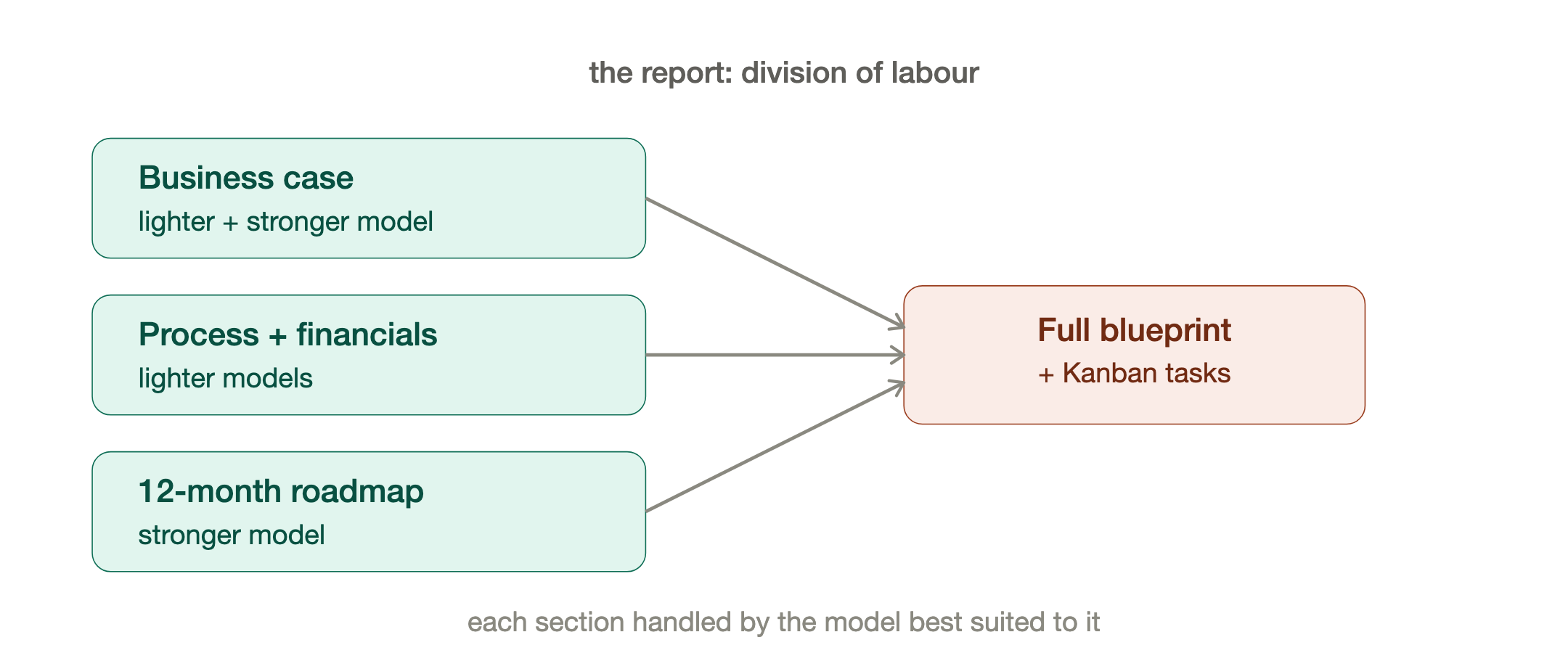
The reports use multiple AIs too, but the other way round — division of labor instead of competition. The plan is built in sections, and each section is handed to the model best suited to it: lighter, cheaper models for the structured process and financial work, a stronger model for the strategic twelve-month roadmap. The finished report provides all the information you need to understand and assess the idea and also step by step tasks on how to build that business, and the same task library that writes the plan also populates the Kanban board, so the planning and the doing never drift apart.
That's the product. Here's the part I actually want you to take away.
All the way through building BluCanto, I kept needing things. And every single time, instead of going and paying for a SaaS subscription, I just built my own — because once you have the AI chops, building it yourself is faster, cheaper, and a better fit than you'd ever expect.
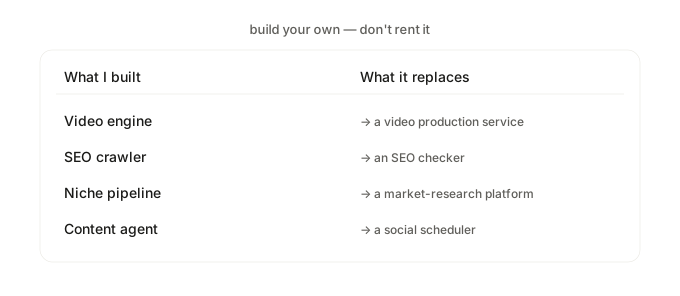
I needed great explainer videos for the site, and I didn't want to pay a production house or a per-minute AI service. So I built my own video engine — the engine that made the video in Part 5.
I needed to know whether the site had broken links and basic SEO problems before launch. There are paid tools for that. I built my own crawler instead — it walks every page, checks every link, and hands me a report. That too is a service or product that could be sold on its own.
I needed market data to feed the product. That's the niche pipeline — which, again, could be sold as a standalone service.
And I needed to actually market the thing without spending my evenings posting. So I built a little content agent: I draft ideas into an Airtable board, approve the ones I like, and it builds them out into complete articles and posts them to X and LinkedIn automatically, on a schedule.
Every one of those is something you can pay a company a monthly fee for. A video tool. An SEO checker. A market-research platform. A social scheduler. I pay for none of them, because I built my own, and they do exactly what I need and nothing I don't. That's the quiet revolution here. The marginal cost of a bespoke tool has collapsed to almost nothing.
Which is the real message of this whole series, and the reason I wrote it for people like us. The barrier was never the coding — the agents do the coding. The barrier is the discipline to specify what you want, the judgment to know when it's right, and the willingness to climb the ladder one rung at a time. Those are exactly the skills a good IT or SAP consultant already has. Eighteen months ago, building a SaaS plus its own video studio, its own research engine, and its own marketing automation would have meant a team and a budget. I did it on a laptop, a home server, and a cloud server, in my spare time. Anyone reading this can now do the same. Once you’ve developed your chops, you can design and build very nearly whatever you want.
And that's why BluCanto is just the beginning. Once it has stabilized and is scaling I have a pipeline of ideas waiting to dedicate some time and tokens to.
If these concepts are something that you or your company might have a need for, feel free to reach out to me. I am looking into developing these concepts and how to incorporate AI as a core part of my SAP offering for my clients, helping people and organizations make exactly this leap — not the hype version, the working version. Helping consultants 10x their own delivery, and helping businesses figure out where AI genuinely fits, where it doesn't, and how to adopt it without betting the company on a demo. If that's a conversation you want to have, feel free to reach out.
If you've followed all six parts, thank you. Go and look at BluCanto if you're curious what the end of this road looks like — www.blucanto.com. But more importantly: pick a rung, and start climbing. The ladder is shorter than it looks, and the view from the top is genuinely something.
— Jerome
Originally published on LinkedIn, July 5, 2026.