
AI & Automation ·
From Prompts to a Production Software Factory: An SAP Consultant's 18-Month Journey into AI
Like many of you, I have been trying to untangle how our industry and work will change in the face of AI. I know it will make a profound difference to ourselves as consultants, project managers, and within organizations looking to implement SAP and other IT systems. Even though it hasn't made such a massive impact yet, I spent the last year and a half on my personal journey developing my own AI skills as a user and now a developer. I wanted to share my journey and how this can help in my day-to-day business, as well as a rapidly developing sideline business.
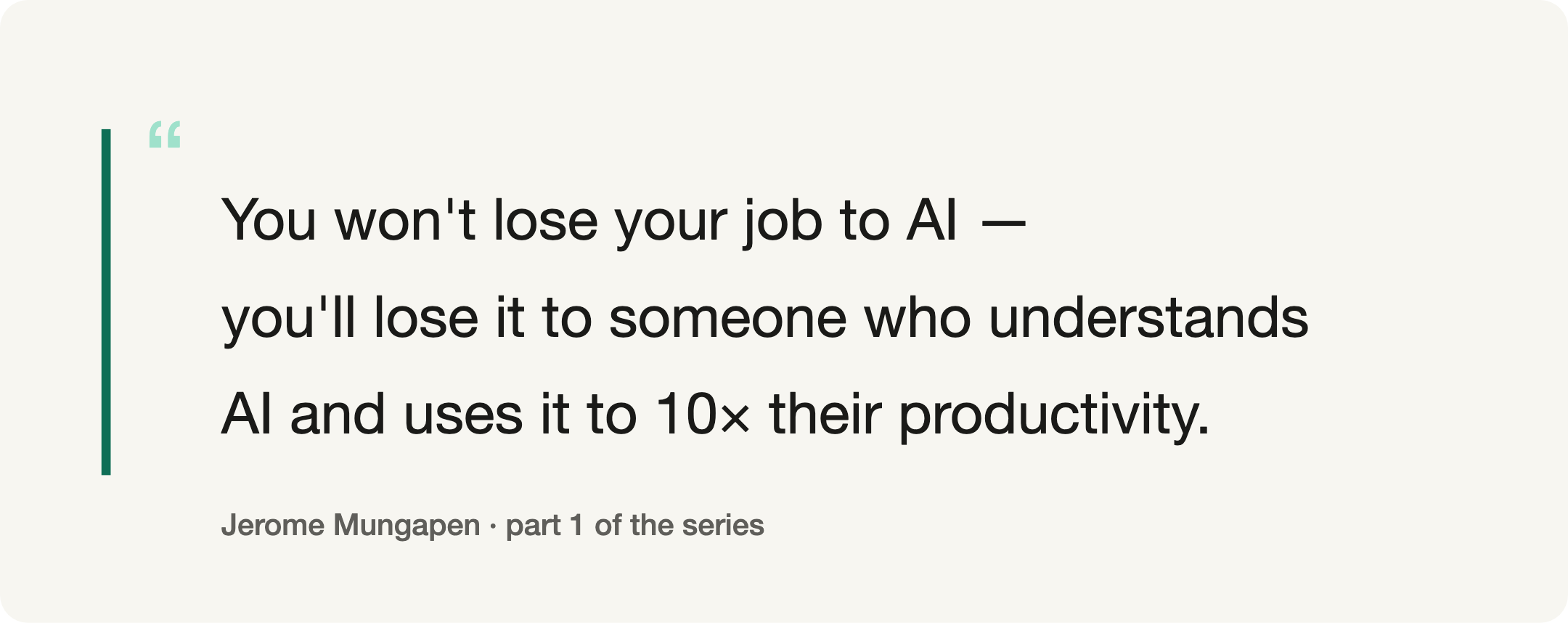
You've probably heard all the doom scenarios and all the abundance scenarios. No one knows for sure which way it's going to end up. My opinion is leaning towards abundance. But after a transition that could be particularly painful to many. You won't lose your job to AI, but you'll lose your job to someone who understands AI fully and uses it as a tool to 10x their productivity.
Luckily for us, I think SAP and the Enterprise are large moving ships will take a long time to change course. I don't think it's realistic that a global 50 company will put critical infrastructure code into their production systems with no one reviewing or understanding what the code does, at least not in the short term. But it's guaranteed that code will more and more be developed by AI, reviewed and tested by AI, and then elevated to fewer and fewer humans to make architectural and higher-level decisions.
These won't be vibe coded, but they will be specification-driven and test-case validated in more rigorous ways than we typically do today.
How do you prepare to be in a position to take advantage of this new future? That's the question I've been asking myself, and that's what I spent the last 18 months of my spare time leaning into.
For most people, “using AI” still means opening a chat window and asking a question and getting an answer. That's where I started too. It is not where I am now.
Over the last year and a half I've gone from typing prompts into a chatbot to running my own autonomous software development shop on a hybrid setup of local and frontier models. A system where AI agents plan, write, test, review, and ship real code while I sleep. Along the way I've launched a live SaaS product, built an AI companion that runs entirely offline on a small edge device, and stood up a 24/7 AI agent on a home server that can orchestrate code development and that I can message from anywhere.
But what's that got to do with my day job? Nothing? Maybe everything. I'm writing this series for the people with similar backgrounds to myself — the IT professionals, the SAP consultants, the folks who've spent careers making enterprise systems work — because I think most of you are still on step one, and the gap between step one and where this technology actually is right now is enormous. It's also the most fun I've had in my career.
Here's my journey from AI catawampus to AI first consulting, and what each stage unlocked.
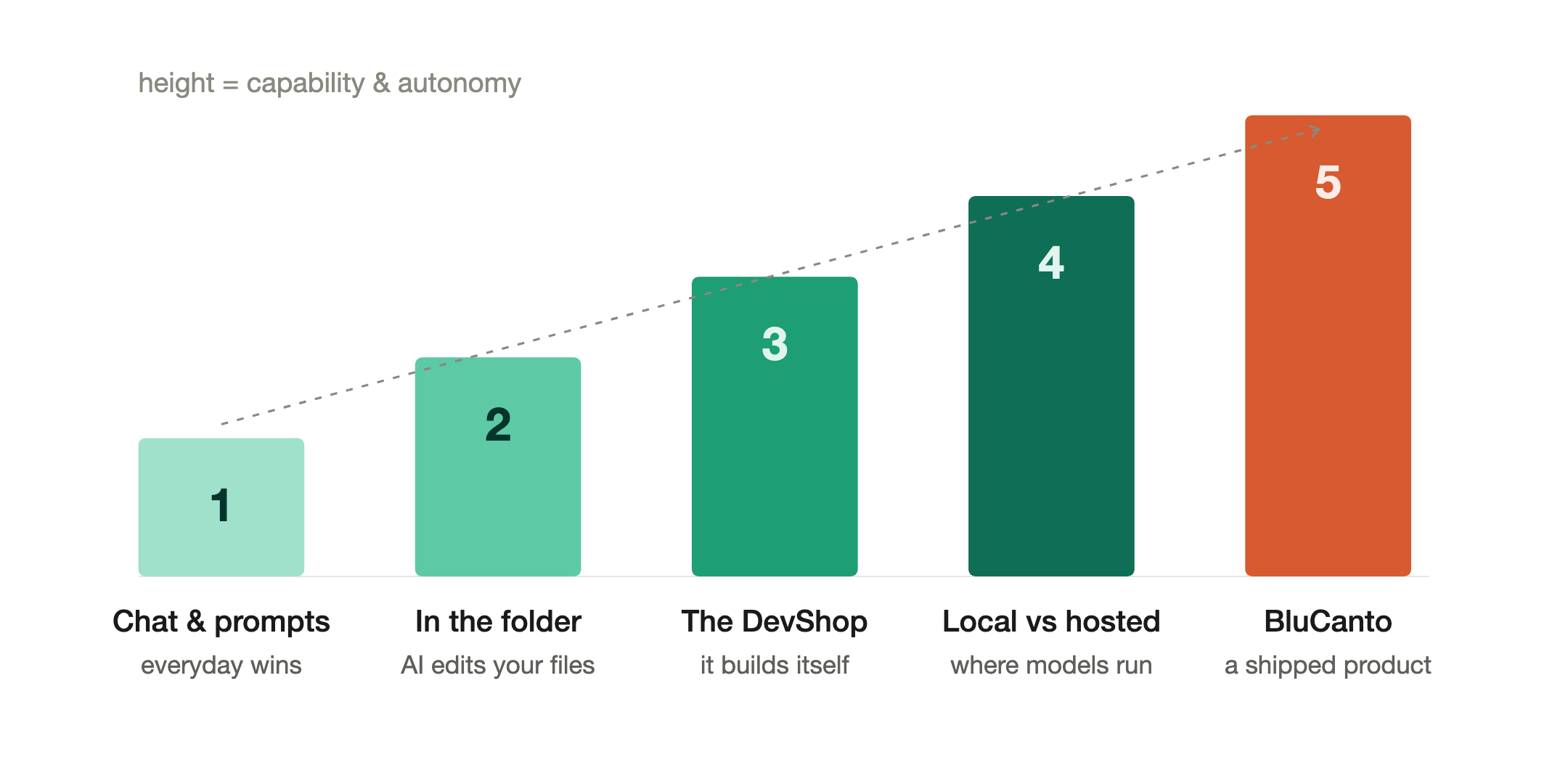
Stage 1 — Chat, prompts, and Projects
. Everyone starts here, and there's real value even here. Turning a one-hour meeting transcript into clean minutes and action items. Building an Excel template from a plain-English description. Drafting the first 80% of a document you've written fifty times before. If you do knowledge work — and especially if you're a consultant billing for your time — this stage alone pays for itself. I'll show you exactly how in Part 2, including a few tricks with custom GPTs, projects and NotebookLM that most people haven't touched.
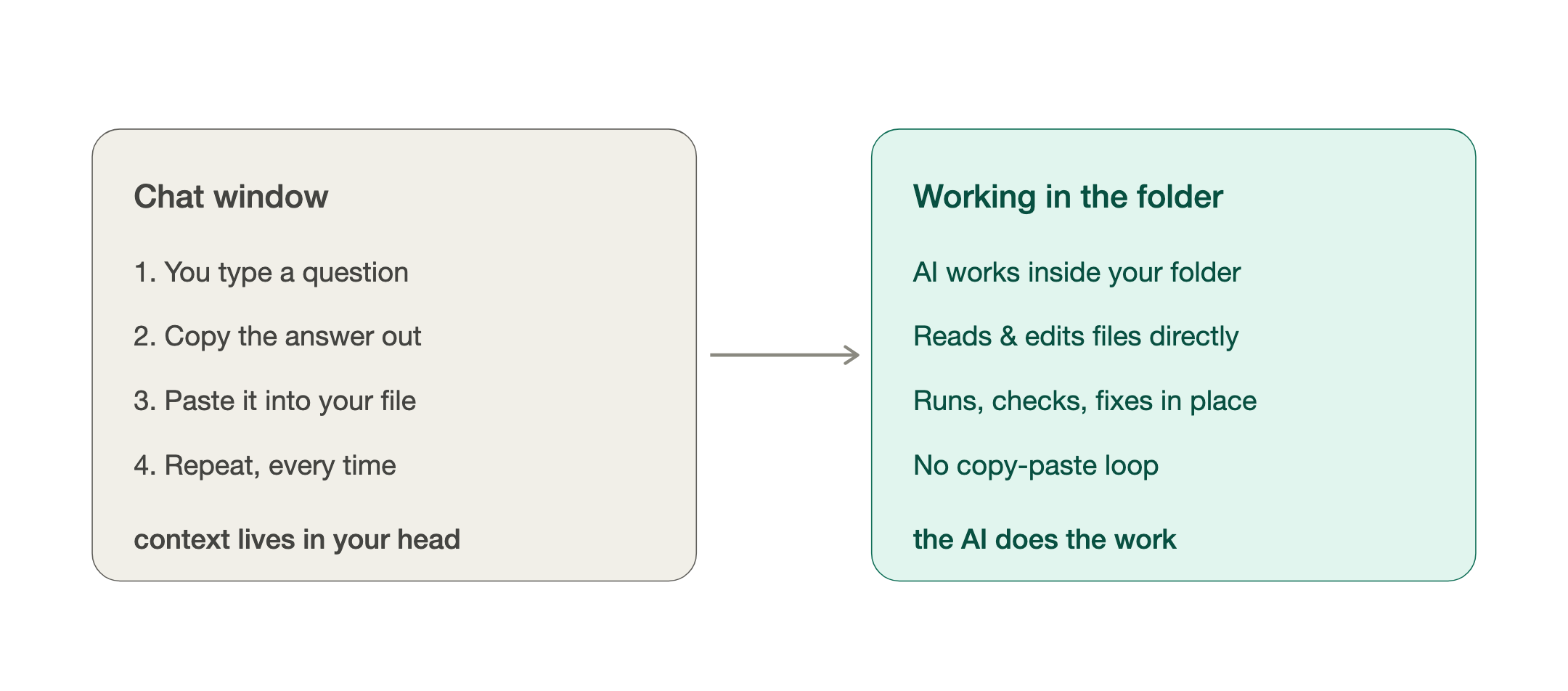
Stage 2 — Working in the folder
. This is the unlock almost nobody outside of software has discovered. Instead of copy-pasting between a chat window and your work, you let the AI operate directly on your actual files — your spreadsheets, your scripts, your documents — in a real folder on your machine. Tools like Claude Code, Codex, and CoWork turn the AI from a conversation into a colleague that does the work in place. I've used this to manage projects for myself (mostly personal) and build small productivity tools for myself that would once have needed a developer and a two-week ticket.
Stage 3 — Building the factory
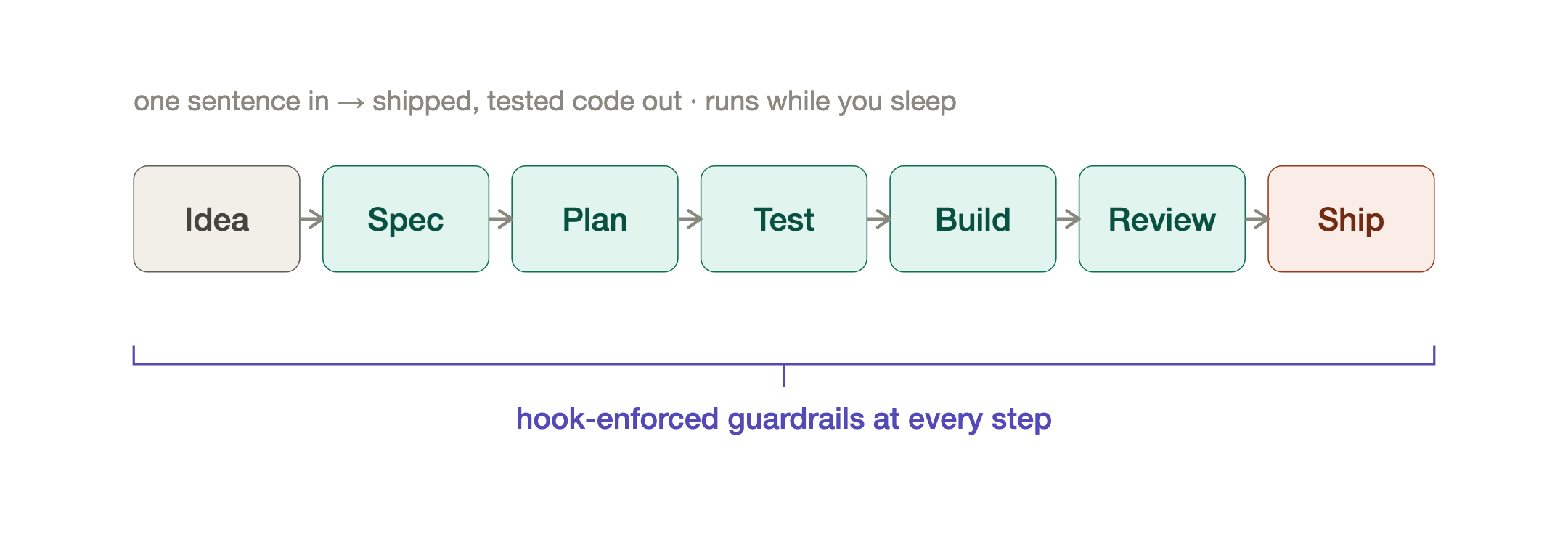
. Eventually I stopped using AI to build things and started building the thing that builds things. I created my own “DevShop” — a harness that takes a one-sentence idea and runs it through requirements, planning, test-first development, autonomous coding, code review, and deployment, with guardrails enforced at every step. I run a personal AI agent on a home server that executes work around the clock. This is the part that sounds like science fiction and is, in fact, just running.
Stage 4 — Local vs. hosted AI
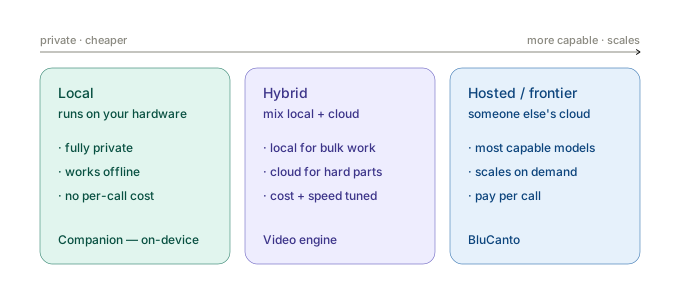
. Not everything should run in someone else's cloud. I built an offline elder-care companion that does speech, memory, and computer vision entirely on local hardware — no data ever leaves the device. I built a media production engine that mixes local and cloud models depending on cost and speed. If you work in enterprise IT, the local-vs-hosted decision is about to land on your desk, and I'll give you a practical framework for it.
Stage 5 — Going all-in on a real product
. All of this converged on one thing: BluCanto (blucanto.com) — a live AI product that helps people find and plan a viable business idea. It started as a research exercise in ranking business opportunities, I found the one I believed in, and I went all the way to a shipped, paying-customer SaaS. That story — the full arc from idea to production — is where this series ends.
Why does this matter for you, specifically?
Because the skills that made us good at enterprise IT and SAP — understanding process, decomposing problems. Working with users to decode what they mean when they use a word loosely, incorrectly, or if it has a different meaning to them than it does to others in the industry. This is THE core skill that will make you invaluable as a human in the age of agents. Knowing what “done” and “tested” mean — are exactly the skills that make AI dramatically more powerful in the right hands. The people who will get the most out of this technology aren't the prompt hobbyists. They're the ones who already know how systems are supposed to fit together. That's us.
Over the next several posts I'll take you up the same ladder I climbed, one rung at a time, with real examples you can copy:
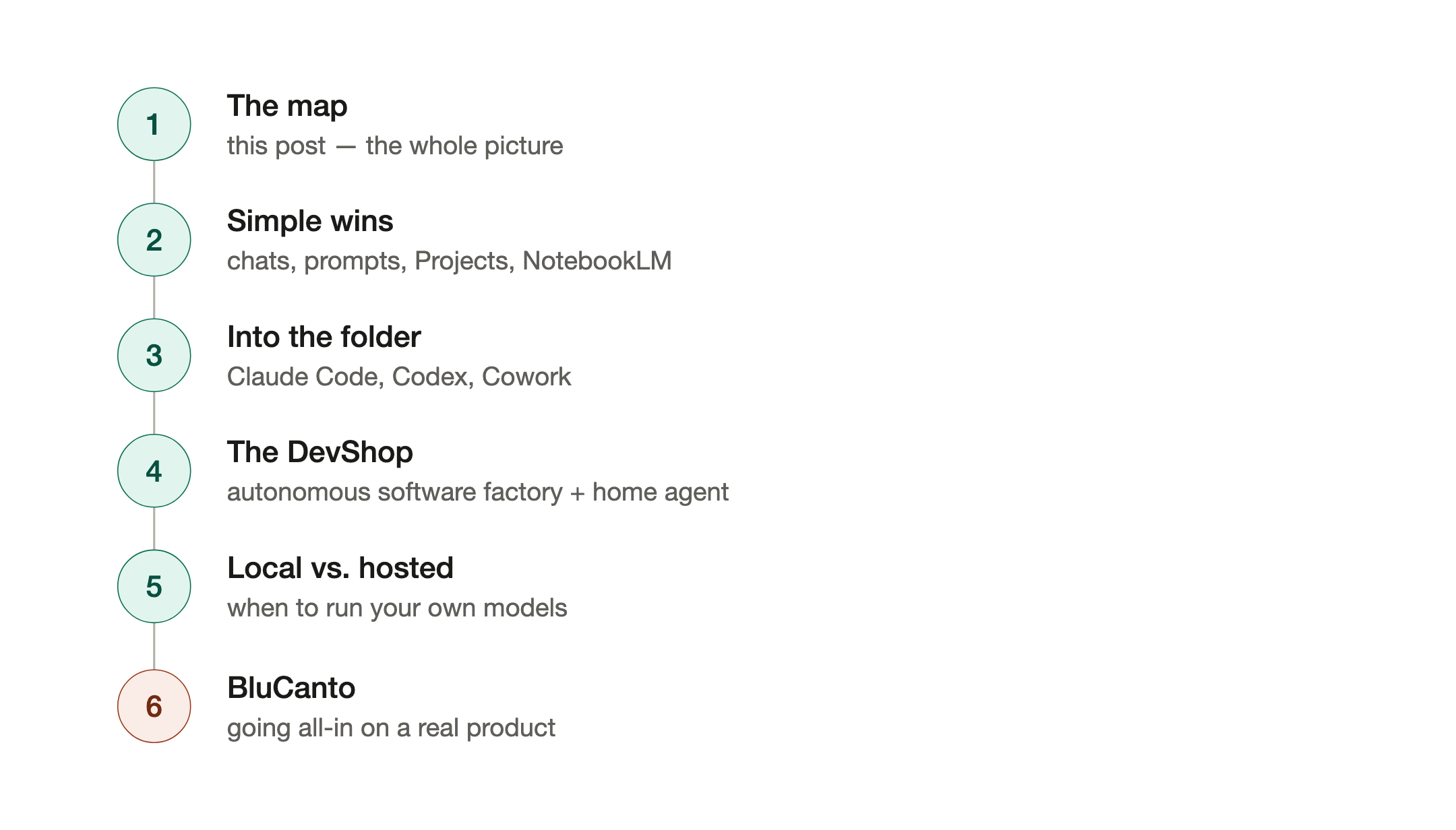
- This post — the map.
- Simple wins — chats, prompts, Projects, NotebookLM for everyday work.
- Into the folder — Claude Code, Codex, Cowork, and the tools I built with them.
- The DevShop — my autonomous software factory and the home agent that runs it.
- Local vs. hosted — when to run your own models (with a video built by my own AI media engine).
- BluCanto — going all-in on a real product as a real learning challenge (you need to deliver something real).
I'm also, increasingly, helping people and organizations figure out how to actually adopt this — not the hype version, the working version. If that's a conversation you want to have, follow along, and let's talk.
Start with the next post. I promise the rope ladder is shorter than it looks.
— Jerome
Originally published on LinkedIn, June 28, 2026.